

Sometime during September 2010, I turned to using the spiritual technology of labyrinths as a means of attending to a series of breakdowns I experienced in my mid-thirties. Initially, medication had eased the symptoms, but over time I began to employ other, more holistic coping strategies that seemed to help though I didn’t understand why. As my symptoms eased, the questions I had about what was happening to me intensified; more than anything, I longed to understand why. Why had I felt so broken? What was it that was actually happening? The onset of these depressive episodes had erupted with what I called ‘oozy goo’, a psycho-spiritual ‘substance’ that felt like it wasn’t mine; the goo hadn’t formed in me but was coming through me from somewhere else. Encouraging of self-inquiry, the labyrinth led me into a vast, inward journey that took in various landscapes including intergenerational trauma; ecopsychology; epigenetics; ancestral healing; and the concept of the motherline, among others. I will return to these topics in future posts, but now it feels pertinent to travel further back and begin with the strange story of how labyrinths first entered my life.
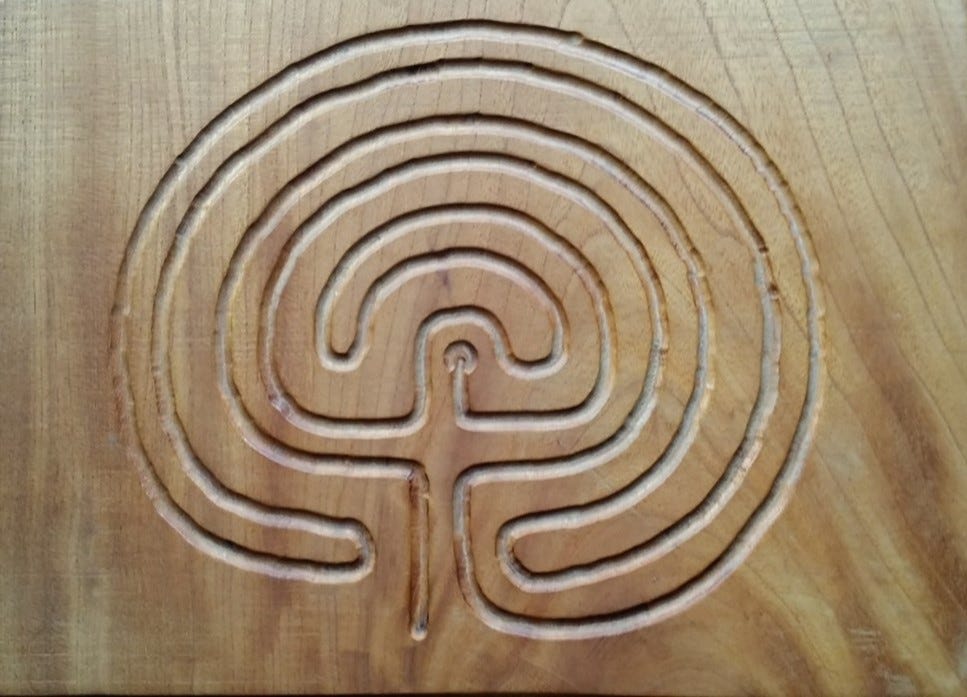
Wooden finger labyrinth. Author’s photo.
The Call of the Labyrinth
In autumn 2004 while studying in Plymouth, UK, I had a dream in which I saw myself walking into a bookshop on the barbican, the old harbour area of the city. In the dream, I asked the bookshop owner if he needed any help, specifically with selling his books online. The dream was lucid and stayed with me, though I did not act immediately.
Three weeks later I awoke with a bolt: “Today is the day I need to go to the barbican, find the bookshop, and speak to the man,” I said to myself. I dressed quickly and took a bus into the city, arriving so early I had to walk around for a few hours waiting for the shop to open. When it did, I spoke with the owner who confirmed that “just the day before,” a bookselling colleague called Ray had been into the shop asking if he knew anyone who could help him sell the stock from his now-closed bookshop online. I called Ray and after a brief meeting, began working with him. Six months later Ray advised me he was retiring and gifting his stock and business to me. Among the stock were three or four titles on the labyrinth. Handling them aroused my interest, but it would be some time before I heard and heeded the call to open them.
Five years later, in autumn 2009, I was married with two children. When our youngest turned six months, we decided to move back to Japan, spending time with my Japanese father-in-law who had been living alone since his wife died. Packing up, I donated much of the remaining bookshop stock to a local, non-profit community art project, but filled seven or eight boxes with hand-selected titles of interest to take with us. The labyrinth books made the cut, but still, it was not yet time to open them.
Time passed. In autumn 2010, my husband and I took work opportunities in the quiet, seaside town of Tateyama in Chiba prefecture, a peninsula southeast of Tokyo. The move was not easy, and this particular day found me alone at the kitchen table in a not untypical moment of despair. Without warning or thought, an image of the labyrinth books in the cupboard arose in my mind. As if in a trance I stood up, walked to the cupboard, and pulled out the books, still in the boxes they had travelled from England in. One book in particular spoke to me, its ocean-blue cover embossed with a seven-circuit labyrinth, Helen Curry’s The Way of the Labyrinth. Running my fingers over the cover, I felt the invitation within the labyrinth’s curves to explore and discover. I did not realise at the time how life-changing this moment would turn out to be.
Within days I was drawing labyrinths on paper, soon progressing to drawing and walking them on beaches near our home, the sand a perfect canvas on which to walk. Immersing myself in nature and the elements while performing the self-styled healing rituals lifted my broken spirits. Inviting release of the dark thoughts and sadness that at times threatened to drown me, the labyrinth began connecting me to a story much larger than my own. As I walked the labyrinth, the rituals left me feeling embraced and uplifted by the living world; I was no longer alone.
I had been drawing and walking labyrinths for about six months when the Tohoku earthquake struck in March 2011, an experience that changed all our lives forever. I ascribe the series of events that followed the earthquake as coming about through having accepted the initial invitation offered by the labyrinth.
Next: The Roar of the Earth